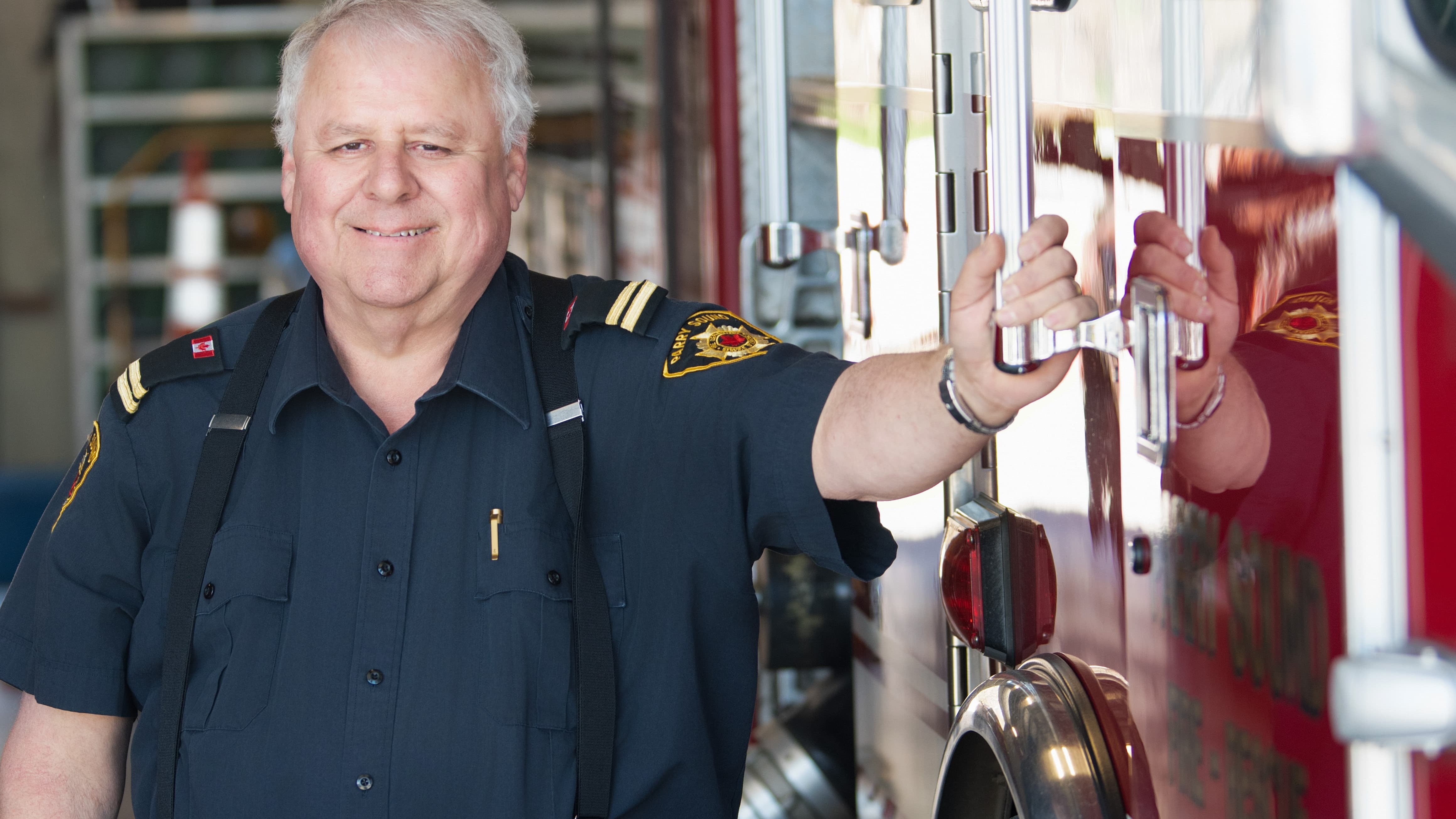

A long serving Fire Prevention Officer and Captain in Parry Sound

People of Parry Sound Project
A long serving Fire Prevention Officer and Captain in Parry Sound
Some people have jobs you can describe easily, but what they actually do is harder to explain. John Tuck is one of them.
In Parry Sound, he is known through the fire department. He has spent decades as a Fire Prevention Officer and Captain, working within the Town’s Emergency and Protective Services. People encounter him in different ways. Some meet him during inspections in their homes or businesses. Others know him through school visits, public safety campaigns, or quiet conversations about smoke alarms and fire risk. Some know him from emergency scenes, where his presence is steady and practical. Many know him simply as someone who has been part of the fabric of the town for a long time.
Over the years, his work has been less about dramatic response and more about prevention. He has spent much of his time explaining, advising, and helping people understand how small decisions affect safety. That work does not always stand out. It happens in ordinary moments. But over time, it has shaped how people in Parry Sound think about risk, responsibility, and what it means to look after one another.

Early Life and Family Background
John Tuck grew up in Parry Sound in a large family. Life at home was busy and practical. With many children in the house, there was a natural expectation that everyone contributed. Tasks were shared, time was divided, and responsibility was something learned early rather than explained in detail.
The harbour was part of his daily environment. Time was spent around the water, moving between docks, shoreline, and neighbourhood streets. Like many children growing up in Parry Sound, he spent more time outside than inside. It was not structured. It was just how life worked. You went where things were happening. You paid attention. You figured things out as you went.
His mother was a central influence. In a household that required coordination and consistency, she set the tone. John speaks about her simply, but with respect. She expected people to do their part. That expectation carried forward. It shaped how he understood responsibility and how he approached situations later in life.
There was no clear path laid out toward a career in fire service during those early years. What developed instead were habits. Paying attention. Following through. Taking care of what needed to be done without drawing attention to it.

Childhood and Formative Experiences
Growing up in a small town meant that experiences were shared. People knew one another. Families were connected through school, work, and daily life.
John’s early years were shaped by repetition. Doing chores, spending time outdoors, and learning how to operate within a group. There were also early experiences that introduced him to loss and responsibility. These were not moments he describes in dramatic terms, but they stayed with him. They contributed to a steady approach to difficult situations.
In later years, people would describe him as calm and measured. That did not come from training alone. It was built gradually, in environments where reacting quickly was less useful than staying steady and working through what was in front of him.

Education Training or Early Work
John’s path into the fire service did not begin with a long term plan. It began in a practical way.
He was doing wood stove inspections. It was detailed work, going into homes, looking closely at installations, identifying risks, and explaining what needed to change. It required attention to detail, but also the ability to talk to people in a way they could understand.
At some point, someone suggested he apply to the fire department. It was not presented as a calling. It was more like, you should think about this. He applied, went through the process, and got hired.
There was no single moment where everything changed. It developed over time. Training, early calls, learning how things worked, learning how people reacted. The job became familiar, and then it became part of who he was.

Work Service or Vocation
Within the fire department, John’s work gradually focused on prevention. While response remained part of the role, much of his time was spent in situations that did not involve emergencies.
He conducted inspections, worked with residents and business owners, and participated in public education efforts. He spoke in schools, met with community groups, and spent time explaining how small actions could reduce risk.
He describes his approach in simple terms.
“I’m a salesman.”
He says it casually, but it explains how he works.
He is not enforcing rules for the sake of enforcement. He is trying to help people understand something well enough that they choose to act on it.
That approach carries through everything he does. Whether he is speaking to a business owner, a homeowner, or a group of students, the goal is the same. Make it make sense. Break it down. Give people something they can actually do.
He does not try to do everything at once. It is one step at a time. Fix this first. Then look at the next thing. That way people do not get overwhelmed and walk away from it.
That approach has been noticed by others. One business owner described meeting with him and expecting a checklist, but instead getting a conversation. Instead of being told what was wrong, they were walked through why it mattered. Another person said it more directly.
“He never talks down to people, he talks with them.”
Over time, that builds trust. People begin to see him not only as an authority figure, but as someone who is trying to help them make better decisions.

On the Fireground
Despite the focus on prevention, emergency calls remain part of the job.
When the pager goes off, there is still a shift. It becomes about what is in front of you. Where is it. What is happening. Who is involved.
Being there is not what people think it is.
It is reading conditions quickly. Smoke, heat, structure, movement. Deciding what matters first and adjusting as things change.
There are calls that stay with you. A fire at the Kipling Hotel. A mattress fire that could have gone differently. A call on Beattie Street where timing mattered.
He does not describe these moments in dramatic language. But they are not abstract either. They are real situations where small differences change outcomes.
There are also calls involving children and families. Those are different. They stay with you. They are part of what makes prevention matter. Not in theory, but in practice.
Over time, you begin to see patterns. The same kinds of issues. The same starting points. Fires that begin in familiar ways. That repetition shapes how you think about the work.

Community Life and Daily Routines
Much of John’s work takes place outside of emergency situations. His daily routine often involves moving through the community in a practical way.
He visits homes and businesses, checks systems, and speaks with residents. Most of these interactions are simple. A question about a smoke alarm. A discussion about a furnace. A reminder about something that has been overlooked.
These moments build familiarity. People come to know him as someone they can ask.
One community member described him as “the person you call when you are not sure.” Another said:
“He shows up, explains it, and you feel better about it after.”
That sense of reliability comes up often. He shows up. He answers the call. He follows through. Sometimes that means being there in the middle of the night. Sometimes it means returning to check something that could have been left alone.
That kind of consistency is not dramatic, but it builds trust over time.

Prevention Through Experience
The connection between fireground experience and prevention work is direct.
John has seen what happens when small things are missed. Alarms that do not work. Exits that are blocked. Situations that start small and move quickly.
Because of that, his message stays simple.
“Don’t play with matches.”
It sounds basic, but it reflects something real. Many fires begin with simple, preventable actions.
He does not try to overwhelm people. It is one thing at a time. Install the alarm. Check it. Fix what needs fixing. Then move to the next step.
That approach works because people can follow it. Over time, those small steps add up.

Relationships and Partnership
John’s work is closely tied to relationships within the community.
He has worked alongside firefighters, paramedics, and municipal staff for many years. Within that environment, he is known for being steady. Someone who does not overreact. Someone who understands what needs to be done.
Outside of the department, those relationships continue. Residents, business owners, and families interact with him over time.
For some, that influence is more direct. People describe moments where he encouraged them to take a step they were unsure about. In some cases, that led to careers in fire service or emergency response.
That kind of influence is not formal. It happens in conversations. In timing. In saying the right thing when it matters.

The Educator and Mentor
Several people describe moments where John encouraged them to take a step they were not sure they could take. In some cases, that meant moving into fire service or emergency work themselves.
He does not describe this as mentorship in a formal sense. It is closer to noticing something in someone and saying it out loud.
One person described doing two co-op placements with the Parry Sound Fire Department while struggling through high school. They felt unsure of themselves and out of place. John saw something different. He encouraged them, pushed them slightly outside their comfort zone, and gave them a sense that they were capable. That experience led to becoming a firefighter, and later a paramedic.
Another described meeting John while he was inspecting a door at a church downtown. During the visit, John talked about the fire department and how meaningful the work had been in his own life. When asked if the department was hiring, John mentioned that the application deadline was that same day. The timing made it seem impossible.
Later that day, John returned with an application in hand. He had spoken with the chief, who was willing to wait after the person’s shift so it could be submitted. That moment changed direction. The person went on to join the department and described John as someone who helped shape both the firefighter and the person they became.
These moments are not part of his job description. They happen in conversation, in passing, often without much attention at the time.
In a field where confidence matters, having someone say you can do this, and mean it, carries weight.
Over time, those moments spread outward. They show up in the next generation of firefighters, paramedics, and community members who approach the work in a similar way.

Character and Inner Qualities
When people describe John, certain qualities come up again and again.
Calm. Steady. Practical. Approachable.
There is also humour. Not in a loud way. Just in how he talks to people. Conversations are not only about the task. There is room for something else.
He is known as “Tucky” to many. The nickname reflects familiarity. It suggests someone who can be respected and still be easy to talk to.
Outside of his work, there are small details that people notice. One of those is his Christmas lights.
During the holiday season, his home becomes something people recognize in the community. The display is not small, and it is not something that came together all at once. It has grown over time, piece by piece, year after year.
John talks about it in a way that suggests he knows it has gotten a bit out of hand.
He orders lights online, often more than he planned to. He admits that he probably spends three to five thousand dollars a year on them, though he is careful about how much of that he shares at home. Some of the pieces are not cheap, and some do not last very long. Heavy snow, cold weather, and plastic materials mean that things break and need to be replaced.
There is a routine to it. Local stores know him. One employee, who works in the seasonal section, has made a habit of calling him over whenever new decorations arrive. He will point out the latest display piece and say, “Guess what we’re getting for Christmas this year.” John pushes back and says he is not buying it, that it is too much. Then he comes back a day or two later and buys it anyway.
Over time, the display has grown to the point where even he cannot say exactly how much is there. When asked how many bulbs he has, he does not try to estimate. He just says there are thousands.
At one point, while putting lights up on the front of the house, he was working alone on an extended ladder set against a steep roof. The ladder shifted while he was up near the hydro lines. Nothing happened, but it was enough. After that, some of the lights just stayed up year round. When they fail, they stay where they are.
The display is not part of his role with the fire department, but it reflects something similar. It is consistent. It is built over time. It is done carefully, even if it occasionally goes further than planned. People notice it. They drive by. It becomes part of how he is known.

Later Life and Reflection
After many years in the role, John has seen changes in both the field and the community.
Fire safety standards have evolved. Materials have changed. Awareness has improved in some areas.
But some things remain the same. Fires still start in familiar ways. People still underestimate risk. The work of prevention continues.
What has changed over time is how many people he has influenced. Through conversations, inspections, and encouragement, that impact spreads outward.

What Endures
John’s presence in Parry Sound is built on consistency rather than visibility.
He has spent decades doing the work. Showing up. Explaining things. Taking care of what needs to be handled.
It does not always stand out. But it shapes how people think and how they act.
Over time, that kind of work becomes part of the community itself. People may not always see it directly, but they feel it. Safer homes. Clearer expectations. A better understanding of what matters and why.
Several people described him in similar ways. Someone who was always there. Someone who made safety understandable. Someone who cared about the community and followed through on that in practical ways.
For many, he is not just part of the fire department. He is part of what they think of when they think about Parry Sound. A steady presence over time, shaping how the community looks after itself.
In a town like Parry Sound, that kind of presence matters. It is not always easy to see, but it is there.

Context and References
This story is based on interviews with John Tuck, reflections submitted by family, friends, colleagues, and community members, and publicly available information related to fire prevention and emergency services in Parry Sound.
Relevant community and organizational context includes:
- Town of Parry Sound Fire Department
- Development and Protective Services, Town of Parry Sound
- Local fire prevention campaigns related to smoke alarms and carbon monoxide detectors
- Community education initiatives and school outreach programs
- Parry Sound District emergency services community
Media of John Tuck

Watch a short video narration of John's Story
Article in Parry Sound Life

The People of Parry Sound Project documents the lives and stories of individuals connected to Parry Sound and the surrounding region. Through portraits and conversations, the project aims to capture the voices and experiences that shape the community.