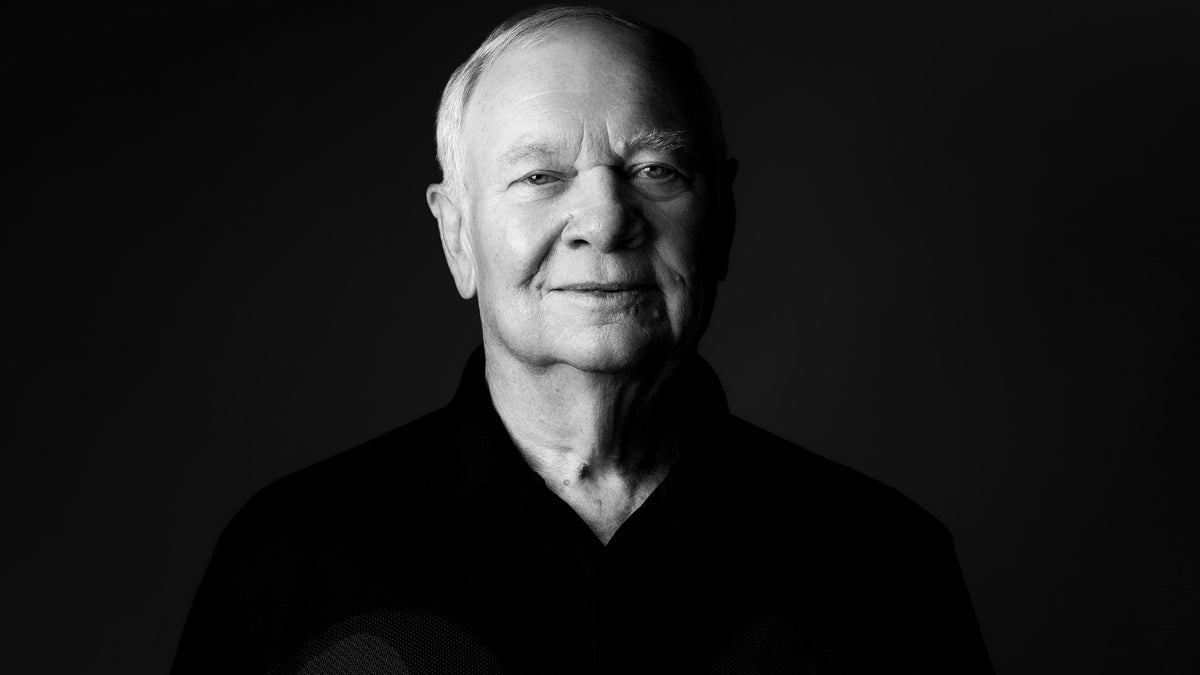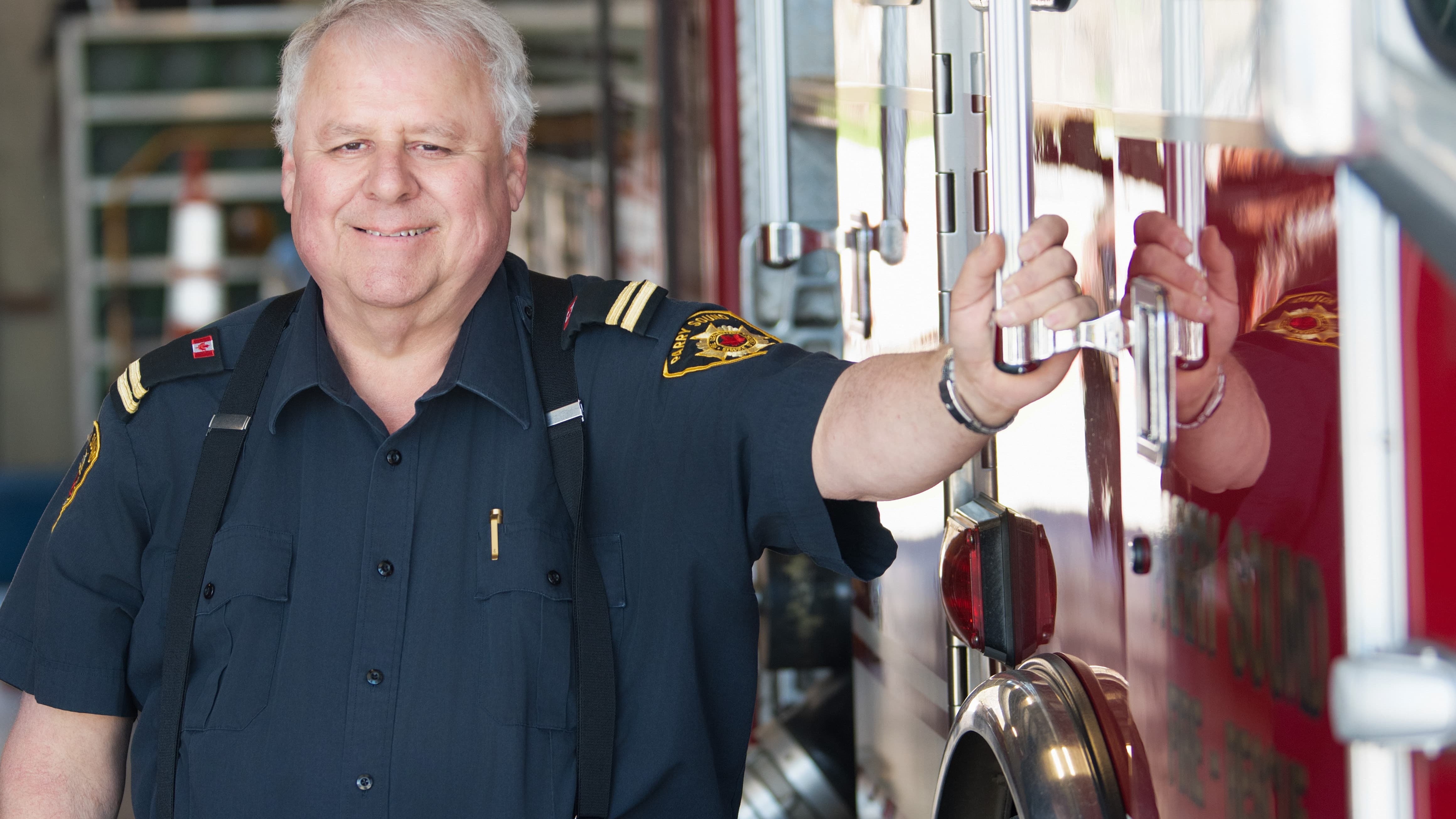

A teacher, volunteer and community builder who has spent sixty years getting people involved.

Raymond Pavlove arrived in Parry Sound in August 1966 with most of his belongings packed into a pink and white 1958 Pontiac Strato Chief. He was 21 years old, recently out of the Royal Canadian Air Force, and about to begin his first teaching job at Foley School. He stopped at the Boston Cafe for lunch, asked where he might find a place to stay, and eventually found a room at Maple Leaf Cottages. He had a couple of weeks to settle in before school started.
Sixty years later, Ray is still here.
Ray spent nearly three decades in education as a teacher, consultant, vice principal and principal. He joined Royal Canadian Legion Branch 117 in 1966 and the Rotary Club of Parry Sound in 1970. He introduced generations of elementary school students to curling, helped connect local students with schools around the world, and organized a community time capsule that will remain sealed until 2087. He also worked with Bobby Orr on Easter Seals events and Hall of Fame induction ceremonies, and participated in educational and volunteer projects that took him to Australia, Thailand, Papua New Guinea and beyond.
In 2026, the Town of Parry Sound named Ray its Senior of the Year, adding to a long list of awards and recognitions. Some are displayed in a room downstairs at his home, although Ray admits that award ceremonies have never been particularly important to him. He once missed an award presentation because he was away on a class trip with his students. His wife, Kathy, accepted it on his behalf. He didn't attend his university graduation either.
Ask people around Parry Sound about Ray, however, and the stories are less about awards and more about the experiences they shared with him. One former student remembers Ray arranging a fire truck ride through town after her curling team won a provincial championship. Another recalls the wooden puzzles he made for her and her sister. Others remember the encouragement he gave them, whether it was helping a young curler develop confidence or asking a shy Grade 8 student to serve as master of ceremonies for the World Interchange Project.
As one former student put it, “Mr. Pavlove looks for the good in everyone and then celebrates it. As a former student, I felt like Mr. Pavlove was always in my corner; he was a safe place.”

Growing Up in Saskatchewan
Ray was born on January 9, 1945, on his family's farm near Arelee, Saskatchewan. He was the fifth of six children, and his father delivered five of them at home, including Ray. The farmhouse had no indoor plumbing, and electricity initially came from a 32-volt system powered by a small gasoline motor.
There was always work to be done. Ray remembers watching his father repair equipment and tackle whatever needed fixing around the farm, often with the boys helping. His mother cooked, sewed and baked, while the girls learned alongside her. Ray was particularly interested in the animals and became known in the family as the cowboy. He had his own pony and horse and helped care for the livestock.
School was three miles away. In warmer weather, the children travelled by horse and buggy, and in winter they rode in a caboose. The one-room school had a barn for the horses, a teacherage and two outdoor toilets. When it closed in 1958, during Ray's Grade 8 year, only eight students remained.
Although the family had little money, Ray remembers a happy childhood.
“I don't ever remember not being happy,” he says.
There were animals to care for, siblings and neighbouring children to play with, and chores that were simply part of everyday life. Looking back, Ray believes those early experiences helped shape his willingness to volunteer and take on responsibilities later in life.
“Responsibilities are just things that you do because you have to do them,” he says. “There's no explanation as to why you have to do them, or no justification or rationalization as to why you're doing something. You just did.”
“Responsibilities are just things that you do because you have to do them.”
He recognizes the same attitude in his brothers and sisters. “We're sort of cut of the same cloth,” he says. “We grew up that way. That's the way it was.”
Ray has since written a book about his early years, Life and Times Grandpa Ray: Growing Up in Saskatchewan, The Early Years 1945 to 1963. He wrote it primarily for his five grandchildren, whom he calls the Awesome Five, wanting them to understand a childhood that was very different from their own.
A Difficult Turn
At 17, Ray enrolled at the University of Saskatchewan. In the background information he provided for this project, he described himself simply as “unsuccessful” at university. But there was more to the story.
When Ray was 15, he and his friend Jimmy rebuilt an old Model A convertible. One Saturday night, they were returning home with friends when the car hit a mound in the road and overturned. Jimmy was pinned beneath the vehicle and died. Ray and the other passengers survived.
Jimmy's father subsequently sued the municipality over the condition of the road. The case went to court around the time Ray started university. Ray was called as a witness, but a mistrial meant the proceedings had to be repeated. He missed weeks of classes while dealing with the court case and the loss of his friend.
“I just gave up on my university and just bombed out,” he says.
Ray worked for a time as a surveyor's helper on the South Saskatchewan River Dam before deciding to join the Air Force. In October 1963, he boarded a train in Saskatchewan bound for Saint Jean, Quebec, where he began his military training.
He became a munitions and weapons technician and was eventually stationed in North Bay. He enjoyed military life and the sense of loyalty among those serving together, but he also wanted to continue his education. He took a university correspondence course and then began considering another possibility. North Bay had a teachers' college, and Ray wondered whether the Air Force would allow him to attend classes during the day and work his military shift at night.
He decided to ask.
The arrangement was unusual, but the Air Force agreed. Ray ate breakfast at the mess, picked up a box lunch and attended classes in civilian clothes. In the afternoon, he returned to the base, changed into his uniform and worked until midnight. Afterward, he prepared lessons for his practice teaching before starting the routine again the next morning.
One instructor at the teachers' college told him he would never make it. Rather than discouraging him, the comment made Ray more determined to succeed.
“I would have never done that with somebody else,” Ray says. His response to someone attempting something difficult would have been: “Great. Let's see if we can make it happen.”
He graduated in 1966.

Coming to Parry Sound
Foley School was Ray's first teaching job. The staff included three older women, Ray, and a principal nearing retirement. Ray was young, interested in sports and willing to take students places. He remembers loading an entire ball team into his car and driving them to Humphrey for games after school. Somehow, nine players managed to fit into the car.
Decades later, one of those students, Paul Borneman, reminded him of those trips.
“Ray, do you remember playing ball and taking us all in your car? All the whole ball team?”
Ray remembered.
That willingness to get involved became part of his teaching career. He taught physical education, organized sports and school activities, and looked for ways to give students new experiences. He eventually became a consultant, vice principal and principal, but when Ray talks about his years in education, his stories tend to focus on students rather than job titles.
His approach was also influenced by other educators. During a teacher exchange in Australia, Ray observed how his principal worked with students. Success was acknowledged with a simple compliment, sometimes at a school assembly, before moving on. When a student needed correcting, the principal handled it privately, without embarrassing the child. A day or two later, he would seek out the student to see how things were going.
Ray adopted a similar approach.
“We're not gonna have a ten dollar discussion over a ten cent item,” he would tell his own children.
The same principle applied in the classroom. Address the issue without making more of it than necessary.
One former student remembers Ray as someone who “looks for the good in everyone and then celebrates it.”
“Mr. Pavlove looks for the good in everyone and then celebrates it.”
When that comment was read to Ray during the interview, he had a simple response.
“Good for the heart.”
The World Interchange Project
One of Ray's largest school projects began with an idea he heard at a Rotary convention in Peterborough.
A Rotary club had sent ten dollars to clubs in other countries, asking each to send something back that represented its community. The items would then be auctioned at an international fundraising night. On the drive home, Ray began thinking about how he might adapt the idea for his students.
His Grade 8 class was raising money for a trip to Niagara Falls. Why not contact schools around the world and exchange information and items with them?
There was no email, so everything had to travel by mail. The students needed to decide which schools to contact, what to tell them about Parry Sound, what to include in their packages and what they hoped to receive in return.
What began as a classroom idea became the World Interchange Project at McDougall School.
The students surveyed the community and prepared information about Parry Sound. They created an audio slide presentation that required someone to change each slide manually at the sound of a bell. They wrote letters, assembled packages and made presentations.
Ray insists that the students made the decisions.
“The important thing to me was it was never about me,” he says. “All decisions were made by the kids.”
“The important thing to me was it was never about me. All decisions were made by the kids.”
As interest grew, the students were invited to speak to Rotary clubs, educational conferences and other groups. Every student had a turn. One day, the school secretary interrupted a math lesson because Bill Bramah from Global Television was calling about the project. Ray checked whose turn it was to represent the class and sent that student to take the call.
The project eventually attracted attention from CBC, CTV, educational organizations and institutions in Canada and the United States. It led to conference presentations and several awards. During a summer course at the University of Toronto, Ray was invited to present the project to his class. He agreed on one condition: his students would give the presentation. They did, while Ray sat in the audience.
Fifty years later, former students still remember the experience.
Linda F. was a shy Grade 8 student who did not like speaking in front of people. Ray asked her to serve as master of ceremonies for a World Interchange event.
“My life changed after that,” she wrote when asked to share a memory of Ray. “To this day I still talk about it to friends and family.”

Curling and Kids
Ray's involvement in curling began soon after he arrived in Parry Sound. He introduced an elementary school curling program at Foley, and over time, similar programs developed in schools throughout the area. Students travelled to neighbouring communities to compete, and eventually the idea grew into the Ontario Provincial Elementary School Curling Championship.
The first championship was held in 1989, with 24 teams from eight schools and Russ Howard serving as honorary chair. The event continued to grow until local curling clubs could no longer accommodate all the teams. Hockey arenas were converted into curling facilities. For the championship's tenth anniversary in Parry Sound, the Bobby Orr Community Centre was closed to hockey during the season and converted into six sheets of curling ice. The arrangement even caught the attention of Maclean's magazine, which called to find out what was happening.
The championship continued for 36 years, involving thousands of young curlers.
One of those curlers remembers the 1994 championship in MacTier. She and three friends competed with Ray as their coach and won the provincial title. Ray arranged a dinner afterward, gave the team a keepsake and persuaded the town to arrange a fire truck ride through Parry Sound for the new champions.
“He made us feel like ‘rock’ stars,” she recalled.
Ray remembers making the arrangements.
“These guys are provincial winners,” he remembers thinking. “See if they can go on the fire truck.”
And they did. Four young provincial champions rode through Parry Sound on a fire truck, with the horn sounding as they made their way around town.

A Message to 2087
In 1987, Parry Sound was preparing to celebrate its 100th birthday, and residents were being asked for ideas. Ray was driving to Sudbury for a meeting when he began thinking about a community time capsule.
His idea was to give families, organizations and community groups the opportunity to purchase individual modules for $100 each. The modules would be placed together in a vault and opened on Parry Sound's 200th birthday in 2087.
Ray thought they might sell 1,000.
They sold 229, representing several thousand people.


Students at William Beatty School raised enough money to purchase ten modules for people and groups who might otherwise have been left out. They helped decide who should receive them, choosing seniors, community groups and even inmates at the Parry Sound Jail.
The inmates were invited to include their own messages.
“Whatever they wanna say,” Ray recalls. “They can plead guilty. They don't have to plead guilty.”
Other capsules contained buttons, marbles, kitchen utensils, small balls, tools and everyday objects. Students also interviewed people in their eighties, preserving memories that will reach back almost two centuries by the time the vault is opened.
The vault remains on Tower Hill. Ray still visits occasionally, and when he notices tourists wondering what it is, he sometimes walks over to tell them the story.

Rotary, the Legion and Bobby Orr
Ray joined Royal Canadian Legion Branch 117 in 1966. His early involvement included supporting Air Cadets and helping organize public speaking and poster contests in local schools. In 1970, he joined the Rotary Club of Parry Sound, beginning an association that would last 54 years.
Rotary became part of family life. Ray attended meetings around the world, hosted exchange students and participated in projects both locally and overseas. He helped organize Bobby Orr Easter Seals Skate-a-Thons, Kurl for Kids bonspiels and golf tournaments supporting the Bloorview Hugh MacMillan Centre. He also wrote a history of the club, Celebrating Rotary in Parry Sound: 75 Years, 1936 to 2011.

His association with Bobby Orr continued when the Charles W. Stockey Centre and Bobby Orr Hall of Fame opened. Ray helped develop the Hall of Fame's induction process and worked on four ceremonies honouring more than 20 inductees. Preparing their stories meant interviewing people across Ontario and beyond, often travelling to meet them in person rather than relying on telephone calls or email.
Ray estimates he spoke with about 200 people.
“I had to tell their story,” he says.
One woman who later took over the induction ceremonies remembers spending a year learning from Ray. She was 20 when they met, and she credits the experience with helping launch her career.
“I would thank him for being a mentor, for providing me with opportunities to build a network and my skills, and for setting a beautiful example of community leadership that I truly believe I used as a base to launch my own community support in Sudbury.”
Ray's military experience also remained an important part of his life. In 2015, he and Tom Traversy started Curlers Care 2-4, a series of bonspiels supporting military families and veterans. The events were held in communities across Canada and raised more than $150,000.
Ray understood some of the difficulties veterans faced through his own experience. His work around munitions had damaged his hearing, and he spent years applying and appealing for recognition before Veterans Affairs eventually acknowledged that part of his hearing loss resulted from military service.
Now, when Ray and Kathy travel on cruises, he attends gatherings for military veterans. He looks for fellow Canadians and asks whether they know about the benefits available to them. On one cruise, a veteran with hearing loss listened to Ray's experience, learned where to find the information and made the call from the ship.

Family
For all the projects Ray has been involved in, the conversation frequently returns to family.
He and Kathy have been married for 58 years. Their daughters, Cory and Debby, both became teachers. The family also includes their sons-in-law, Steve and Andrew, and five grandchildren: Claire, Charlie, Amanda, David and Jack.
“The best to last, family,” Ray wrote in the background information he provided for this project.
Years ago, Ray and Kathy decided that rather than filling the space beneath the Christmas tree with gifts their grandchildren might not need, they would spend more of that money on experiences together. The family has travelled and taken cruises together. And if a grandchild needs shoes or something else during the year, Ray sees no reason to wait until Christmas.
“Family is number one,” he says.
Having recently become a grandfather myself, I was interested in what Ray had learned from the experience. With five grandchildren and years of memories behind him, what advice would he offer someone just beginning that part of life?
“Try to be not something that you're not, and just seize the moments as they come up.”
For Ray, that means taking an interest in their lives, showing up for Christmas concerts and sports days, and being supportive without being overbearing. Above all, giving them the freedom to become who they are.

Still Curious
At 81, Ray is still interested in what comes next.
He is curious about artificial intelligence, whether service clubs will continue to attract volunteers, and how communities will provide services to those who need them. He wonders how organizations such as Rotary and the Legion will adapt in the years ahead.
He also continues to tell stories. Downstairs, there are binders filled with photographs and newspaper clippings, awards with stories attached to them, and the book he wrote about growing up in Saskatchewan. He has plans for another book. There are stories about Thailand and Australia, curling and Bobby Orr, schoolchildren and Rotary meetings, veterans and community projects. Ray frequently gets partway through one story before remembering another.
Near the end of our conversation, I asked Ray how he looked back on everything he had done, from his childhood in Saskatchewan and his years in the Air Force to his family, teaching career and sixty years in Parry Sound.
He thought for a moment.
“Wanting to do things that would make me proud that I had done them, and they would benefit others.”
His thoughts then returned to Saskatchewan and the car accident when he was 15, something he says he doesn't like to think about.
“I could have been the one,” he said.
He wondered aloud whether surviving that accident had something to do with the life he went on to lead.
“Maybe I was spared for a reason.”

Context and References
About this story
This profile is part of the People of Parry Sound Project, an ongoing photography and storytelling initiative documenting the lives, experiences and contributions of people connected to the West Parry Sound community.
Raymond Pavlove's story is based primarily on a recorded personal interview, written background information and historical materials he provided, and memories shared by former students, colleagues, friends and community members. These firsthand accounts helped document not only Ray's accomplishments but also the influence he has had on others throughout his sixty years in Parry Sound.
Historical and community context
The story references Ray's involvement with several local organizations and initiatives, including Foley School, McDougall School, William Beatty School, the Rotary Club of Parry Sound, Royal Canadian Legion Branch 117, the Ontario Provincial Elementary School Curling Championship, the World Interchange Project, the Parry Sound Centennial Time Capsule, Curlers Care 2-4 and the Bobby Orr Hall of Fame.
Additional Reading
World Interchange Project
-
- Read about the WIP (World Interchange Project)
Time Capsule
Other
-
- My Rotary Story: World Interchange Project — Ray Pavlove — Ray's own account of the international educational project developed with his students.
- Life and Times Grandpa Ray: Growing Up in Saskatchewan, The Early Years 1945 to 1963 — Ray's personal account of his childhood, written for his grandchildren.
- Celebrating Rotary in Parry Sound: 75 Years, 1936 to 2011 — A history of the Rotary Club of Parry Sound written by Ray. Celebrating Rotary’s 75 years in Parry Sound
Curling

Awards and Recognition
- Senior of the Year, Town of Parry Sound. See Ray receive this award, starting at 3:00.

- Order of Parry Sound
- Elola Todd Lifetime Achievement Award, Ontario Curling Association
- Canada 125 Award, Government of Canada
- Queen Elizabeth II's Diamond Jubilee Medal. See Ray's Award
- Hilroy Fellowship Award, Canadian Teachers' Federation
- The Hilroy Fellowship Program recognized innovation and excellence in professional teaching practices across Canada.
- Read about Ray's award
- Significant Achievement Award, Rotary International
- Parry Sound Citizen of the Year
- Project Milestone Recognition Award, Columbia University, New York
- Fred L. Bartlett Award, Ontario Public School Trustees Association. Read about Ray's award
- Social Sciences and Humanities Research Council of Canada Award
- Paul Harris Fellowship, Rotary International
- Ontario Easter Seals Society Awards
Acknowledgements
Thank you to Ray for generously sharing his memories, photographs and personal history, and to the former students, colleagues, friends and community members who contributed their recollections. Their perspectives helped tell a fuller story of his life and his contributions to Parry Sound.
Media of Ray Pavlove

Listen to a short narration of Ray's Story
The People of Parry Sound Project documents the lives and stories of individuals connected to Parry Sound and the surrounding region. Through portraits and conversations, the project aims to capture the voices and experiences that shape the community.