

People of Parry Sound Project
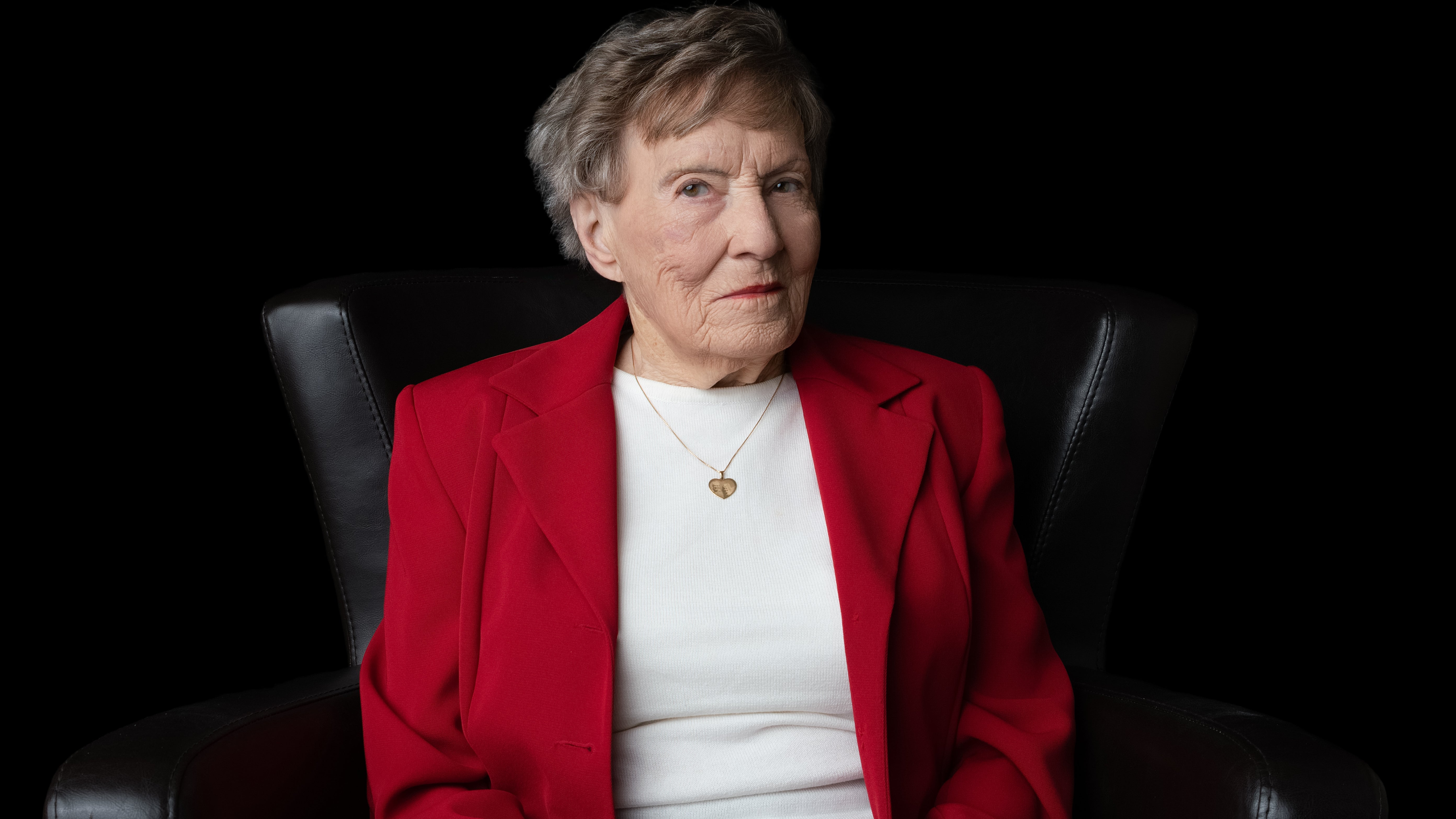
In the summer of 1924, in the small Ontario farming town of Tottenham, a baby girl arrived so quickly that her mother, Rachel, joked she was almost born in the onion patch. It was about eleven o’clock in the morning on July 28th. By the time her mother reached the top of the stairs, there she was: four pounds five ounces, jet black hair, and so tiny that her head fit in the palm of a hand.
Her father, Horace, had been hoping for a boy. “My Daddy thought I was a boy,” Ellen later wrote. “And thereafter, apparently he treated me as such.” He lifted her into wagons, let her sit beside him on the sulky cart, and put the reins of the big Clydesdales in her hands when she was still a very small child. Before she was three years old, she was riding bareback down to the creek while the horses had a drink.
Her name came from another strong woman. Mrs. Mayer, an older woman in her eighties, who had been like a second mother to Ellen’s mother, Rachel. When the baby arrived, Rachel named her Ellen Myrtle Marie, carrying forward a friendship and a kind of gratitude that would echo throughout her life.
The farm that Horace bought outside Tottenham was not easy land. Ellen remembered it as “a pile of rocks,” but her mother simply said, “We are poor now, we have to make do.” They grew a big garden, kept horses and beagles, warmed the house with lamps and woodstoves, and went to church every Sunday at eleven, Sunday school at three, and back to church again at seven.
There was no bathroom, only an outhouse. Saturday night baths took place in a tub in the kitchen. Her mother washed the children, while her father waited in the rocking chair with a warm towel to wrap around each one. At the table, a single lamp lit their meals. It was a world of horses and hot bricks under the carriage floor, of long winter Sundays and careful discipline. No slang, no swearing, no fighting, lots of chores and lots of church.
Ellen was one of six children: Bessie, Muriel, Murray, Edith, Ellen, and Kenneth. They would eventually live in Saskatchewan, Tottenham, Beeton, Gordon Bay, and Parry Sound, Ontario, and Ellen would attend nine different schools. But the first place that shaped her was that farm in Tottenham, with its kittens in potato sacks, its hard winters, and its constant expectation that children would work and look after one another.
As a girl, she was quick, bright, and full of motion. Relatives nicknamed her “Flash Gordon” because she was always running, climbing trees, playing baseball, and looking for action. That energy, and a kind of stubborn courage, would be tested very early.

Childhood Hardship and Growing Up Too Soon
Loss, responsibility, and the end of innocence
The Great Depression in Canada (1929 to 1939) hit farm families hard across Canada, and Ellen’s family was no exception. Her father lost the farm during those years. She remembered her mother, Rachel, lying at the top of the stairs one day, ill and exhausted. When Ellen came home from school, the doctor arrived and took her mother to the hospital in Alliston. That alone was frightening. In those days, she said, if a doctor arrived at the house, it meant real trouble.
One afternoon, her father sat at the kitchen table and cried. He told her he had no money to buy groceries. The family had only a cabbage and a turnip in the house. Then Aunt Gertrude arrived, baked bread, and a neighbour across the street helped them through. It was a small rescue, but Ellen never forgot the feeling of scarcity, and the way extended family and neighbours stepped in.
That summer they left town and moved north. They came to Gordon Bay and eventually into the Hamer homestead, near what would later become Rocky Crest Resort. Her Aunt Bessie built and operated the first lodge there. Ellen remembered her sister Muriel, still a girl, washing dishes and pots in the lodge kitchen and heating water on the big cookstove. Everything was scrubbed and carried by hand. There was no automatic, anything.
Then came the day that split her childhood in two.
Her father owned a chestnut mare named Beauty. He took great pride in the horse and in the sulky cart that he had modified, replacing the old seat with a black leather one and yellow wrought iron trim so that his little girl could ride with him in style. They often drove down the lane by Hamer Lake and out to the road.
One morning, something let go at the front of the cart. Horace reached over to fix it. Beauty bolted. The horse lunged forward, pulling Horace out of the cart and dragging him along the road. Ellen, only nine years old, hung on, afraid that the horse would run straight through her mother’s garden. Fortunately, the gate was closed. Beauty stopped, frothing and stamping. Ellen jumped over the fence and ran to the house.
Her mother, eight months pregnant, told her to go back. “Your Daddy will be walking home,” she said. But he was not walking. Ellen found him lying on the road, a deep cut on his head, bleeding, not talking, and lying very still. She ran back again and told her mother that he was not walking, that he was bleeding.
With no telephone, Ellen had to row across the lake with her sister Muriel and then walk along the road to their Uncle John’s farm. Uncle John fetched the truck and gathered the neighbours. By the time they brought Horace back, he had died.
While the adults gathered downstairs, Ellen remembered sitting upstairs with her brothers and sisters, praying beside her parents’ bed and eating soda crackers. She would later write about the funeral and the wreath of water lilies on the coffin, because her father loved water lilies. She also remembered that the left side of her own body was black and blue from hanging on to the cart.
Three weeks after her father’s death, her brother Ken was born. Her mother then suffered a partial stroke on her left side. There was no space left for Ellen to be a child.
“I grew up overnight,” she wrote.
A girl was hired to help in the house. Ellen described her as “useless,” but at least she stayed with her mother and baby Ken while the older children were at school. Ellen started getting up at five-thirty every Monday to do the washing. There was no automatic washer. She used a dolly, a hand wringer, and a clothesline where the garments would freeze solid in winter. In summer, her mother planted a huge garden and preserved everything, including meat, in the cold pantry.
By the time the small insurance payout was gone, her mother received twenty dollars a month and five dollars for each child from the Government of Canada. When the children turned sixteen, they had to leave home and work. Ellen completed grades nine and ten, then went to Parry Sound to work for room and board helping a woman with boarders while she tried to attend grade eleven.
She failed algebra that year. She also contracted scarlet fever and was in convulsions for more than a day. The family was quarantined until March. When she returned to Parry Sound, she did not go back to high school. She went to work.
Through all of this, she stayed close to her mother. “My mother, she is the strongest individual I ever met, raised six kids by herself,” Ellen said later. If she could relive one hour of her life, she said, it would be an hour just to see her mother again.

Answering the Call to Nursing
From hospital kitchen to operating room
Ellen found work in the kitchen at St. Joseph’s Hospital in Parry Sound. She earned eight dollars a month plus room and board. She scrubbed, washed dishes, and helped wherever she could.
One day, she noticed Sister Justine, a nun, scrubbing a stairwell. Ellen took the brush and pail from her and finished the job. Sister Justine took note. After that, Ellen often went to help her in the laundry.
Soon, Ellen was called to the office. She was 19 and terrified she would lose her job, which was $8 a month plus room and board. , Instead, she was asked what she would have liked to be if she had been able to finish school. “A doctor,” Ellen said, “or a nurse, or someone who runs an orphanage.”
Sister Justine told her that her uniforms and books were already waiting. She was to report to class at 7:30 am the next morning. Ellen worried about her mother and about money. She said she needed to send wages home. They told her, “We can look after that.”
She started as a student nurse, still remembering how some student nurses had looked down on maids. That contrast left a mark on her. She wrote later, “That taught me a good lesson. Never think you are better because you are higher on the pedestal professionally. Someone has to do the menial chores and they are very important.”

Training was demanding. She worked twelve-hour days, doubled up on wards, and was called at any hour for deliveries. At that time, nurses and doctors were treated as almost sacred authority figures. The equipment was basic, the hours long, and the expectations high.
Ellen loved the operating room. During a tonsillectomy, a surgeon struck her across the knuckles with a metal instrument because he did not like the way she held a tool. She did not flinch, in fact she laughed! The doctor and supervising Sister were shocked. After that, the surgeon always asked for her to assist. She earned a reputation for calmness, steadiness, and for quietly doing what was best for patients, even when that meant standing her ground.
By the end of her three-year program, Ellen had assisted in about 400 major surgeries and approximately 90 births, and had even delivered one baby on her own. She received the Proficiency Award for the Operating Room. When the Catholic hospital wanted her to stay, she told them she wanted to work at the General Hospital so she could care for mothers and babies.
Nursing was more than a job. It was a way of standing beside people in the most fragile moments of their lives. Decades later, she would still say that nursing changed her life the most. “I loved it,” she said simply.
Never think you are better because you are higher on the pedestal professionally. Someone has to do the menial chores and they are very important.

Meeting Bill
A wartime love story in Parry Sound
Ellen first saw Bill Gilchrist when his sister Camille was in hospital giving birth to Charleen. Ellen was nursing on the ward. Bill’s mother, however, made it clear that she did not think a nurse from Ellen’s background was good enough for her son. Ellen remembered her as “crabby,” and recalled being unfairly accused of taking money. It was not an easy start.
Later, at a street dance on the main street of Parry Sound, everything changed. It was the first of July. Ellen stood with a group of four girls. She saw Bill walking across towards McKinley’s store. She told her friend that he was coming to ask her to dance. Her friend said no, “he was coming for you Ellen”.
Bill asked her to dance. She said she could not. In her church tradition, dancing and card playing were not allowed. She had never learned. Bill persisted. They danced. When he walked her back to the nurses’ residence at St. Joseph’s, he asked if she would go to the show with him the next time he came home from camp. She agreed.
They saw each other several times that summer, going to the movies, swimming, boating, and mostly talking. Bill was 19, Ellen was 17. He served as a physical instructor with the Governor General’s Foot Guards Regiment Third Division. The war was still underway and he was due to go overseas.
He proposed in his own straightforward way. “Give me your left hand,” he said, and slipped the ring on. He did not make a speech. “We just looked at each other,” Ellen wrote. “That was enough.”
He later said that she was the nicest and prettiest girl he had ever met after their first date, and that he knew she was the one for him.
They became engaged on September 2nd, 1944, and were married on December 5th at 7:00 pm at the Presbyterian church in Parry Sound. Ellen wore a white lace gown and an orange blossom head dress. They held a buffet reception for about 75 guests in the living quarters of Bill’s grandparents, who owned the Kitchener Hotel, located at 24 Gibson Street, in Parry Sound.
Her mother, Rachel, told her that evening, “I love the boy you are about to marry. God bless him.”

Bill was on embarkation leave. Ellen did not realize how soon he would go. On the train back, he got off at Camp Borden without saying a formal good-bye. She was upset, but she did what she always did: lifted her chin, prayed, and went back to work. She wrote him letters every night while he was overseas.
World War II took many young men from Parry Sound and the surrounding region. Ellen remembered learning that a friend, Mickey, had been killed in the Italian campaign. She met Bill’s mother on the bridge the day the telegram arrived. The grief in that moment deepened her sense of what Bill, and all of them, were facing.
When he returned from overseas, like many veterans he took some time to settle. Eventually he and his father made an agreement about managing the Kitchener Hotel in the late 1940s. It was the start of several decades in hotel and motel work for Ellen.
Bill was beautiful dancer, such a romantic. If I was working in the kitchen or whatever, if the music was something to dance to, we would look at each other and start dancing.
Bill's last words to Ellen were "Just remember darling, I will always love you."

Building a Home and Raising a Family
Marriage, motherhood, and everyday life
Ellen and Bill moved into a small basement apartment in the hotel. Space was tight and money was tighter. At one point, they were $65,000 in debt with mortgages and business loans. For 8 years they had no vacation. A doctor told Ellen that if she did not get away, she would have a nervous breakdown. They went to the bank, borrowed $700, and spent two weeks in Bermuda. She came back feeling that she could clean the hotel by herself.
Her mother, who had moved to Parry Sound in 1942, sewed until she was eighty-six and helped care for Ellen’s children, Tony and Trudi, when needed. She was a joyful grandmother, who spoiled them, played with them, and left the house in a cheerful mess.
Grandpa Tony (Anthony (Tony) Gilchrist), Bill’s father, loved his grandchildren. He would take them to the cottage on Georgian Bay, part of Lake Huron, supposedly for a day. They would stay a week or more. He teased them, showed them off around town, and made sure to create special memories.
Ellen and Bill eventually bought a property on Oak Avenue and built a family home for $17,000. Thirteen years later they sold it for $33,000. In that house, life settled into a pattern that their children remember fondly. Sunday was family day. There was minor hockey, Trudi’s figure skating, music lessons, church choir, sleigh riding down the hill in front of the house, and always lots of friends coming and going.
They had a black Labrador named Jet for nine years, and a small white chihuahua named Tinker. Ellen cooked large meals and insisted that the house be kept in good shape. She later admitted that she was probably too fastidious, that she “knocked herself out” trying to keep everything perfect while working long hours at the hotel.
She was also endlessly creative. She sewed skating costumes and play outfits for Trudi, made overalls for Tony, and even sewed dresses for her mother-in-law and outfits for nieces. She baked raisin tea biscuits, macaroni sausage casserole, and her mother’s Christmas cake. Thanksgiving at the cottage included duck hunting, fishing, games, singing, and dinners with turkey, mashed potatoes, turnip, cauliflower, cranberry salad, coleslaw, pumpkin pie, and far too many desserts. Christmas meant turkey, plum pudding, mince pie, and a house full of people.
As a wife, she tried, in her words, “to be the perfect housekeeper,” to consider Bill’s wishes first, and to do as much as she could for him and for their children. She also had clear advice for marriage. “Fifty-fifty,” she said. Everything shared. Friends noticed that Bill changed diapers, looked after the children, and did many tasks that were usually left to mothers at that time. Ellen was proud of that.
Trudi remembers that no matter how busy the hotel was, “she was still always there for my brother and me, no matter what.” Later, her daughter-in-law Lynda would say that Ellen treated her like a daughter from the first day they met.

The Kitchener Hotel Years and Community Leadership
Business, community, and leadership
For thirty-three years, Ellen and Bill co-owned and operated the Kitchener Hotel and Motor Inn in Parry Sound. It was more than a business. It was a meeting place. Travellers, salesmen, construction workers, local families, and visitors from far away all passed through the dining room and bar.
Ellen prided herself on running an efficient kitchen. Everything was made from scratch. When she caught a cook trying to sneak in a pre-made pastry shell, she fired him on the spot. Standards mattered. At the same time, she cared about staff as people, not just as employees. Colleagues remember that she watched out for them, listened to them, and expected hard work in return.
If the hotel was full, extra travellers were sometimes lodged at their home so that no one was left without a bed. One family friend, whose parents first met the Gilchrists in the late 1950s while buying a cottage, recalled being welcomed into their home as a teenager. He still remembers a brunch at their house overlooking the bay, the calm way Ellen ran the kitchen, and the sense that he was being treated like an adopted son.
In town, Ellen served on the ladies’ executives of both the Parry Sound Golf and Country Club and the Curling Club. She was a Brownie leader, chaired the local Cancer Society, and helped with countless church suppers and community events. Bill and Ellen were often at the centre of organizing, hosting, and quietly making sure things got done.
Friends remember that there was a time when Ellen was considered one of the best dressed women in Parry Sound. She was a gifted seamstress and made many of her own clothes, as well as outfits for her daughter Trudi. One winter coat in particular stood out: a tailored red coat, paired with a black fur hat and muff. When Ellen walked uptown to run errands, people noticed. She carried herself with confidence and quiet elegance, and more than a few heads turned as she passed.

A Nurse at Heart and a Life of Service
A lifelong commitment to care and service
Ellen’s formal nursing career slowed as hotel responsibilities grew, but her identity as a nurse never left her. After raising her children and working many years in the hotel and motel, she later returned to the hospital as a volunteer in the Emergency Department at the West Parry Sound Health Centre (Parry Sound hospital).
She became the first official volunteer based in that department and stayed for thirteen years, right up until COVID-19 restrictions brought her time there to a close when she was 95 years old. Staff called her “Staff Sergeant Gilchrist.” To others she was simply “Grams.”
The Emergency Department is not always an easy place to work. One nurse said, “She helped me survive working in a very negative environment during the early stages of my career.” Her presence, humour, and quiet steadiness made a difference.
She was known for making sure patients were comfortable. If someone was sitting in the air-conditioning and looked cold, she would track down a blanket, tuck it around them, and take the time to chat. She was also famous for tracking down pillows. Nurses would send her out when the supply ran low. She always came back with a stack. No one was entirely sure where she found them, but the staff nicknamed her “the Pillow Police.”
There is a story from those years about a young male nurse who was being a little too sharp with her. Ellen tapped him on the backside and said, “I’m over 80, and I changed your diaper when you were little, so there!” The nurse, and everyone within earshot, laughed. It was a reminder of the long threads of connection in a small community hospital.
She baked cookies for staff and brought treats for patients. One colleague wrote later that Ellen’s compassion, supportive presence, and positive attitude “showed me the true meaning of care within a healthcare setting and helped shape me into a better healthcare worker and person.”
When asked which skill mattered most in her nursing, she could list many: technical skill, calmness under pressure, leadership. But what she returned to most often were the simple tasks and the way people were treated. She remembered the days when she carried stretchers up stairs with other nurses, stood for hours beside burn patients, or helped surgeons repair tendons in the middle of the night. She also remembered how it felt to be a maid, and she never forgot to respect every role, from cleaners to surgeons.
Her mother’s motto stayed with her. “You can do anything if you put your mind to it and help your neighbour.”

Island Years and Georgian Bay
Community, courage, and summer life on the water
Although work and family life centred on Parry Sound, Ellen’s heart also belonged to Georgian Bay. The family spent summers at Gordon Bay and later on an island that became a gathering place for neighbours and visiting friends, including families from the United States.
Bill and Ellen’s island, Jawasi, sat in the Bateau Island group. Long before cell phones and internet, they were a kind of hub for that small community. Boats were always coming and going. They helped open and close cottages, did minor repairs, upholstered furniture, hosted dinners, and kept an eye out for anyone who needed a hand.

One neighbour from the United States remembers being ten or eleven, watching Ellen cut her grandson Darcy’s hair on the dock before he went water skiing. She kept laughing and calling out for him to hold still. Others recall how she would jump off the dock holding her nose and doing her own version of a scissor-kick jump that no one else could quite imitate.
A grandchild wrote, “My siblings, cousins and I spent summers at the island. Grams and Gramps were the local go-to’s for that group of islanders. She never turned anyone away, was quick to join in the fun with any kids, and even now, almost thirty years later, those same islanders and their children make a special attempt to stop in and see her when they are here.”
Island life also brought her nursing skills into use. One summer, a neighbouring family brought their terminally ill father to the cottage on a gurney for what they knew would be a last visit. His catheter came out. They had no doctor nearby, only the knowledge that “Ellen is across the bay.”
Ellen helped without hesitation. After some careful trial and error, she managed to reinsert the catheter and ease his discomfort. She did not make a fuss about it. She simply did what needed to be done.
Ellen never knew her own grandparents. She sometimes wondered if that loss made her even more determined to be present for her grandchildren and great-grandchildren. She and Bill took them skiing in Vermont and Banff, travelling to Quebec, Bermuda, the west coast, the east coast, Spain, Portugal, the British Isles, and eventually to Florida, where they wintered for many years. Yet no matter how far they travelled, she always said, “There is still no place like Georgian Bay.”

Later Life and Spiritual Sight
Faith, memory, and reflection across a century
Across 101 years, Ellen witnessed remarkable changes. She was born before widespread television, refrigerators, highways, air travel, or national phone service. She lived through the Great Depression, World War Two, the building of new highways to Parry Sound, and the rise of everything from cassette tapes to computers, microwaves, helicopters, jet planes, plastic, nylon, laser surgery, heart bypass operations, and modern intensive care.
She watched the moon landing on television and remembered how extraordinary it felt. She drove in a white and red convertible that Bill bought for her, and later took helicopter rides that would have seemed impossible in her childhood. Bill earned his pilot license simply because he wanted to fly and once landed on a beach to take his father for a ride.
As the world sped up, Ellen’s inner life also deepened. Faith had always been part of her. As a girl, she had walked to church three times on Sundays. As an adult, she kept a favourite hymn: “I will walk with God,” and loved simple songs like “Jesus loves me.” She believed in prayer, gratitude, honesty, and considering the feelings of others. Her values were clear: keep in touch with God, be thankful for each day, be honest with yourself and others, and be ready to give of yourself.
In later years, she also spoke frankly about visions and dreams. After Bill died, she saw him sitting on the side of the bed, putting on his clothes, telling her, “You will be all right.” On another night, she dreamed that he was sitting on the bed again, getting ready to leave. She asked for a kiss before he went. “I have to snow plow,” he said. In the dream, she insisted on the kiss before he stepped away.
She also dreamed of her mother, holding her husband’s head on her lap and shaving him with a straight razor that had a pearl handle. These images comforted her. They suggested to her that the people she loved were still connected to her in some way.
When asked whether these visions brought joy or sadness, she said they brought both, but mostly comfort. They reminded her that her life had been deeply rooted in family and faith.

What People Loved Most About Ellen
Character, humour, and how she made people feel
People who know Ellen describe her with a consistent list of traits: humour, determination, kindness, energy, and a generous heart. One grandchild summed up three words: resilient, tenacious, talented. Another described her as loving, funny, kind. A friend called her “even-keeled, active, and persistent.”
She heard these descriptions and answered in one short word.
“Humble,” she said. “Oh, I am so humble.”
She liked to tell the truth plainly. When asked how she had stayed at her mother’s side and taken on so much responsibility, she said, “I just put my feet on the ground and kept going.” When asked what advice she would give about being herself, she said, “Just be yourself.” When asked what lesson she hoped would live on in her family, she said, “Love one another.”
Ellen has a huge, loving heart that shows in everything she does. She loves life, accepts everyone, and that generosity has shaped her children, grandchildren, and great grandchildren. A truly wonderful presence in Parry Sound.
She loved both of her children, but acknowledged differences, calling Trudi “bossy” with a smile, and saying her son Tony was just like his father in his willingness to help. She adored her daughter-in-law Lynda and said Lynda treated her with great kindness and had her back, especially in later years when Lynda became her full-time caregiver.
Sports remained part of her life long after the “Flash Gordon” days. She curled, golfed, skied, played baseball, and later enjoyed dancing, especially waltzing and jitterbugging with Bill. She loved singers like Bing Crosby and Frank Sinatra, but could not make sense of much of the music on modern radio. Her grandson Sully’s country songs were an exception. Those, she said, were relaxing.
She often described herself as “average” at school, good at spelling, art, and geography, but not an academic star. Yet she also understood that she had been given what she called “more talent than the average female,” in sewing, cooking, organizing, and caring for people. She tried not to boast about it, but she did not pretend it was not true.
Just be yourself. Love one another.

A Legacy of Welcome, Humour, and Care
What endures in Parry Sound and beyond
Ellen’s life stretches from a farm without electricity to a world of digital photography, helicopters, and social media. Through every change, one theme stands out: the way she made people feel.
Family members, neighbours, patients, and hotel guests describe feeling welcomed, cared for, and included. American friends who first came for snowmobiling holidays eventually bought cottages on Georgian Bay because of Bill and Ellen’s hospitality. Islanders remember her stepping in during medical crises as if it were the most natural thing in the world. Former babies grew up to become nurses and doctors who worked beside her in the Emergency Department.
One island neighbour wrote that Bill and Ellen were “the centre hub of the community out in the Bateau Island group, really the heart of that entire community.”
Her grandchildren and great-grandchildren remember the scissor-kick jumps off the dock, the costumes, the cookies, the games, and the sense that their grandmother was fully engaged in their lives. One grandchild wrote, “Grams was just always there, from early childhood memories through growing up, getting married, and having children of my own.”
She never had the chance to know her own grandparents. In response, she tried to be an active grandmother and great-grandmother, present at holidays, at the cottage, and in small everyday moments. For some younger friends who did not have a living grandmother, she quietly stepped into that role as well.
She also thought carefully about what to pass on. Her most precious keepsake was her mother’s engagement ring. She received a ruby pendant from “Grams” on her sixtieth birthday, with earrings to match. She hoped her children and their families would treasure these things and pass them on to a future daughter, because, as she put it, “A daughter is really a joy which a mother cannot explain.”
When asked what she hoped for the future, she wished for peace, less materialism, a return to basic ways of living, more attention to nature, an end to drug and alcohol addiction, and a world where people paid more attention to moral values and to the teachings of their faith. She hoped for governments that balanced their budgets and fewer homeless and hungry people.
She also added one request to the next generation: “Do not ever change. Enjoy life, family, and friends, and great success in your future endeavours.”
Near the end of the interview, she was asked what she saw when she looked in the mirror. She said that she looked like her mother. It was a small, quiet statement, but it carried almost a century of memory. The girl who once watched her mother lie at the top of the stairs with no money in the house now saw her mother’s face and hands in her own reflection.
My mother, she was the strongest individual I ever met, raised six kids by herself.
Ellen’s 100th birthday brought 96 birthday cards, including messages from the King and Queen. She laughed at the size of some of the official cards and stored them carefully. The attention was nice, but what mattered more were the words from people whose lives she had touched.
One long-time friend, Dr. Thomas Smallman, wrote of meeting Ellen and Bill as a teenager in the 1960’s, being welcomed into their home, and feeling an “inner glow” in her presence. Decades later, after Bill’s death, she wrote to him at Christmas, “We had a good marriage and life for sixty-three years, really blessed with supportive family and friends.” It was a simple line that captured the way she saw her own story: not as something heroic, but as a life made rich by faith, hard work, and the people around her.
If Ellen’s story teaches the community anything, it is that a life well lived does not erase hardship. It moves through it. A farm is lost in the Depression, a father dies in an accident, a mother lies in a hospital for a year, a sister dies of cancer at twelve, a husband goes off to war, a young woman leaves home at sixteen to scrub, cook, and work twelve-hour days. Yet out of all of this come strength, humour, generosity, and a steady commitment to service.
She would not describe herself as a hero. She would say she was simply doing what needed to be done. But in Parry Sound, on Georgian Bay, in the wards of St. Joseph’s and the General Hospital, in the Emergency Department and on the island, her presence has been a kind of quiet anchor.
I grew up overnight.
Today, when people in Parry Sound speak of Ellen Gilchrist, they remember her deep love for Bill, her fun-loving energy, her determination, her kindness, and, most of all, how she made them feel. In a town that has grown from rough roads and small churches to highways and helicopters, her story offers a simple lesson.
Keep your feet on the ground. Keep your faith. Help your neighbour. Work hard. Love one another. And never forget that even in the hardest seasons, there is room for humour, cookies, and a scissor-kick off the dock into Georgian Bay.

Context and References
This story is set against the social, historical, and geographic landscape that shaped Ellen Gilchrist’s life. Readers interested in learning more about this broader context may find the following resources helpful:
- The Canadian Encyclopedia: Great Depression (Canada)
- The Canadian Encyclopedia: Canada and the Second World War
- The Canadian Encyclopedia: Italian Campaign
- Government of Canada: Governor General’s Foot Guards
- Town of Parry Sound official website
- Georgian Bay Biosphere (UNESCO-designated)
- Rocky Crest Resort (Gordon Bay area)
- West Parry Sound Health Centre
- Photos of Ellen, and Ellen and Bill, supplied by the Gilchrist family. Thank you.
This story is based on interviews conducted with Ellen Gilchrist in Parry Sound in December 2025.
Media of Ellen Gilchrist

Listen to a short narration of Ellen's Story
Watch a short video narration of Ellen's Story
Parry Sound Life Magazine

This story reminds me of the work of Pamela Newall, Officer of the Order of Canada
The People of Parry Sound Project documents the lives and stories of individuals connected to Parry Sound and the surrounding region. Through portraits and conversations, the project aims to capture the voices and experiences that shape the community.